The Print Is the Performance: Colour Calibration on Cambridge Screens

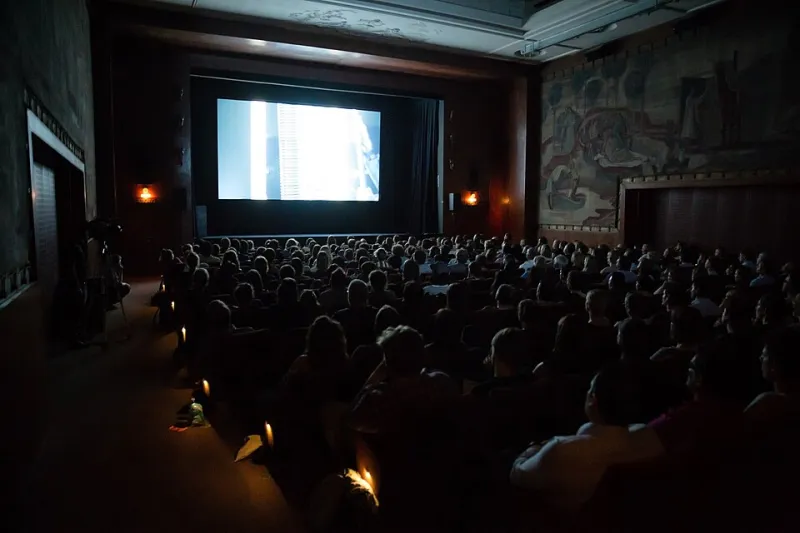
Photo: cinema projectionist adjusting projector in dark auditorium colour calibration, via www.daidegasforum.com
At a festival, the things we talk about are visible: the film, the subtitles, the guest in the post-screening chair. The thing we rarely talk about is the look of the print itself. And yet colour is one of the first things an audience feels. A warm Lagos street at dusk, the chalky light of a Sahelian afternoon, the deep blues of a night-time protest: these are not decorative choices. They are part of how a film thinks and breathes.
When a DCP is projected badly, that thinking gets muddled. Faces go flat. Shadows turn into black holes. Fabrics that should glow look radioactive, or muddy, or simply wrong. For African cinema in Cambridge, where many audiences are encountering these films for the first time, the stakes are higher than they might seem.
The grade is the film’s weather
“A grade sets the temperature of a scene before anybody speaks,” says a London-based colourist who has worked on several West African features and restored classics. “It tells you whether you are in a room with fluorescent light or late sun. If the projection is off, you are not watching the film. You are watching a rumour of it.”
That is not an argument for technical perfection above all else. It is an argument for intention. A contemporary drama might be graded with rich midtones and deliberately saturated fabrics; a restored classic might depend on delicate contrast and density that took a restoration team months to recover. Neither look survives a projector that has been left on the wrong setting because nobody checked.
What goes missing when the DCP meets a tired projector
A DCP is often treated as plug-and-play. It is not. Cinemas are supposed to run projectors at a defined white point, contrast and luminance, but in rooms that double as lecture theatres, with bulbs past their best and ambient light leaking through the doors, the reality is messier. The result is rarely a dramatic catastrophe. It is a slow drain: skin tones lose nuance, dark scenes crush into a single tone, highlights clip, and colours drift either towards neon or towards grey.
“The most common problem I see is not a broken projector,” says a Cambridge projectionist who has worked across festival and repertory screenings. “It is a projector that has never been properly calibrated for the room it is in. You put on a test pattern, it looks fine. You put on a film with deep shadows and dark skin tones, and suddenly you realise you cannot see the detail that the colourist spent weeks protecting.”
That detail matters. It matters for close-ups, for night scenes, for the difference between a character’s face in shadow and a character’s face in darkness. It matters for films that use colour symbolically, and for films that simply want to show a place as it looks.
The Cambridge room problem
Cambridge has beautiful screens and awkward ones. A festival may find itself in a converted lecture hall, a church, a room with a small screen and a projector that was installed for PowerPoint. There is no shame in that. The shame is in pretending the room does not shape the image.
Venues can ask for a calibration run before the first screening: not a full technical audit, but twenty minutes with a test clip from the actual film. If the distributor can supply restoration notes or a reference still, even better. Ask what the filmmakers intended, then check whether the room is delivering it.
A practical checklist for Cambridge venues
- Request the DCP early and ask for any projection notes. Some distributors will flag a restoration’s intended look.
- Test with the film, not only with bars. Choose a scene with skin tones, fabric, shadow detail and a highlight you can trust.
- Check the basics: DCI white point, correct luminance, no “eco” or “bright” mode, and a projector that has been allowed to warm up.
- Look at the room, not just the screen. Close doors, dim house lights, check masking and ambient light.
- Do not “improve” a restoration with sharpness, motion smoothing or extra contrast. Leave the grade alone.
- Brief front of house. If a film has long dark scenes, late entry is not a neutral act.
The point is not to turn every screening into a technical seminar. It is to give the film a fair hearing. Cambridge audiences are generous and curious, but they cannot see what the projector refuses to show them.
The look is part of the ticket
When we programme African cinema, we are asking audiences to trust a film’s world. Colour is part of that trust. A properly calibrated screen does not make a film more “authentic” or more “African”. It simply lets the filmmakers’ choices arrive intact. That is the least a cinema can do, and in a city with so many screens and so much goodwill, it is entirely within reach.