The Long-Distance Screening Club: A Practical Case for Cambridge’s Cinema Twin
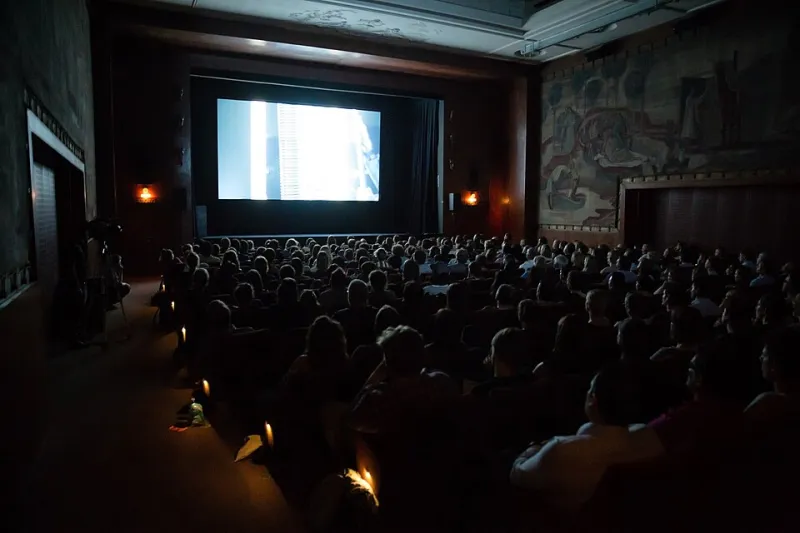
Photo: Manfred Werner - Tsui, CC BY-SA 3.0, via Wikimedia Commons
Cambridge African Film Festival has always been good at bringing films here. The next step might be making sure the room in Cambridge has a counterpart somewhere else — a sister cinema, film club or festival screen in an African city that we talk with rather than simply import from. Not a grand treaty. More a long-distance screening club with a timetable, a shared spreadsheet and a decent microphone.
The idea is simple enough: two venues, two audiences, one film, and a conversation that runs in both directions. The execution is where festivals usually get stuck. So here is a practical case for a cinema twin, written for Cambridge and for anyone in the UK who has ever left an African film screening wishing the discussion had not stopped at the door.
Start with a conversation, not a contract
A twinning should begin with a question: what would our partner actually want from this? Not what would look good in a press release. A cinema in Nairobi, Lagos, Accra, Cape Town or Kigali has its own audience, its own calendar and its own reasons for saying yes. If the relationship starts as a one-way import — Cambridge selects, Africa receives — it will feel like a distribution deal with better branding.
The better starting point is a co-curated slate. Each side proposes two or three films. Each side explains why the film matters to its local audience. Then both sides agree on a short season, perhaps three screenings over six months. That gives the partnership a shape without demanding a five-year plan before the first ticket is sold.
It also helps to be honest about scale. Cambridge is a small city with a festival audience that is curious but not infinite. A partner cinema in a major African city may have a larger footfall or a very different viewing culture. The partnership should not pretend those differences do not exist. It should use them. A Q&A in Cambridge can learn from a post-screening discussion in Dar es Salaam, and vice versa.
What a good partner looks like
The most obvious candidates are not always the best. A venue with a big screen and no curatorial voice is less useful than a film club with a scrappy projector and a regular audience. Look for a partner that already programmes African cinema, or wants to programme more of it, and has someone who can make decisions without a committee meeting every fortnight.
Useful criteria include: reliable projection and sound, a track record of hosting discussions, a clear contact person, willingness to co-select rather than just receive, and some experience with subtitles or translation. Language access matters. If the film is in Wolof, Amharic, Yoruba, Swahili or Portuguese, the partnership needs a plan for English subtitles in Cambridge and, where relevant, local-language subtitles or interpretation for the partner audience.
Existing relationships help. Cambridge has academic, diaspora and cultural networks that may already connect to a particular city or film community. A partner found through a filmmaker, a translator, a university contact or a local film collective is more likely to survive the inevitable scheduling hiccup than a cold email to a generic cinema address.
The practical bits: money, time and subtitles
Money is usually the least romantic part of international collaboration, and the most likely to derail it. The simplest model is a shared cost sheet agreed before the first screening. Each venue covers its own room, staff, local marketing and technical costs. Shared costs — rights fees, translation, captioning, guest honoraria or connectivity — are split according to an agreed formula, not a vague promise to sort it out later.
A small contingency fund is sensible. So is a rule that neither side commits to a filmmaker appearance until the filmmaker has confirmed. Pre-recorded introductions are cheaper and often more reliable than live links, especially when time zones are unkind.
Time zones are manageable if you plan around them rather than pretending they are not there. A 6pm screening in Cambridge in November is 8pm in Lagos, 9pm in Nairobi and 10pm in Cape Town. That can work for a live Q&A, but it can also be a long day for a guest. A recorded conversation, played after the film in both venues, is sometimes the more generous option. The important thing is that both audiences see the same conversation, not that it happens in real time.
Subtitles need a proper workflow. Agree the subtitle language, the caption file format, who checks the timing and who pays for translation. Test the files at both venues at least 48 hours before the screening. A film that plays beautifully in Cambridge can be undone by a subtitle file that drifts by three seconds in another room. If the partner is screening a Cambridge-selected film, share the subtitle file only with the rights holder’s permission. If the partner is screening a local film, budget for English translation rather than assuming someone can improvise.
Make it feel like a conversation
The difference between a twinned screening and a glorified watch party is what happens after the credits. Both audiences should be able to ask questions of each other, not just of the film. A shared digital noticeboard, a post-screening voice note exchange or a short written Q&A can do more than a stiff panel.
One format worth trying: each venue collects three audience questions before the screening. The questions are exchanged in advance, so the guest or curator can respond to both rooms. After the film, each audience records a two-minute response. Those responses are shared with the other venue at the next screening. Over a short season, the two audiences begin to recognise each other’s concerns.
This is where the partnership becomes more than a cost-sharing exercise. Cambridge audiences get to hear how a film lands in the city where it was made, or in a neighbouring country. The partner audience gets to see what a UK festival crowd makes of the same work. Neither room is the default. Both are part of the same screening club.
A small first season
A realistic first season might be three screenings. One is a live-linked Q&A, time zones permitting. One is a pre-recorded conversation with a filmmaker or curator. One is a local discussion in each venue, with notes exchanged afterwards. Keep the titles modest. Keep the promises small. Publish the partnership clearly on both websites, with the same dates and the same description, so audiences can see the relationship is real.
After six months, ask the boring questions. Did audiences turn up? Did the Q&As produce good questions? Did the subtitles work? Did either venue feel like a guest in its own season? If the answers are mixed, adjust. If they are good, add a fourth screening and perhaps a short exchange of written reviews.
The point is not to build a sprawling international network overnight. It is to make Cambridge’s African film programming feel like part of a wider conversation, rather than a annual import with a Q&A attached. A sister cinema in an African city would not solve every distribution problem. But it would give Cambridge audiences something rarer than a premiere: a relationship that continues after the lights come up.