Before the First Frame: The Backstage Craft of Screening African Cinema in Cambridge
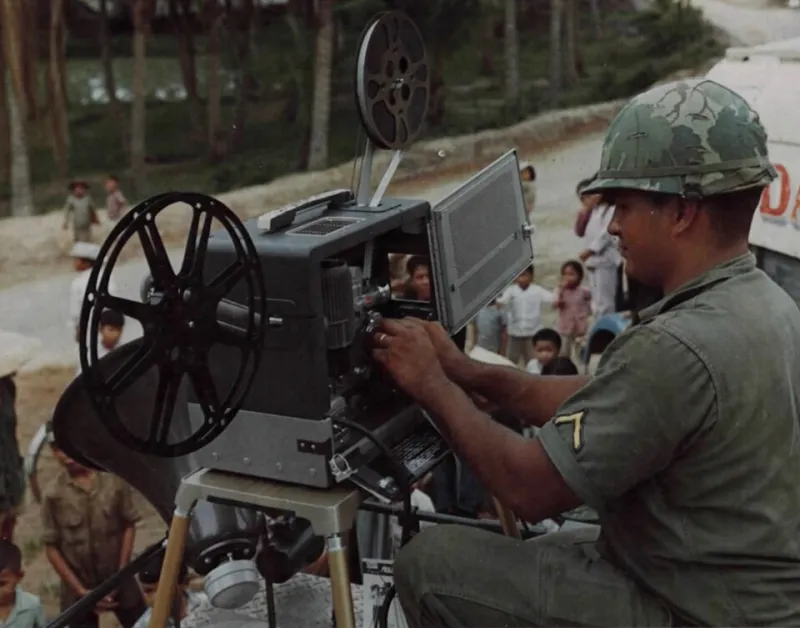
Photo: PFC Wendell D. Garrett, Public domain, via Wikimedia Commons
It is 6:42pm on a festival evening and the auditorium is still half-lit. Someone is crouched by the projector testing a subtitle file. Someone else is on the phone to a rights holder about a screening licence. A front-of-house manager is moving a lectern two feet to the left. None of this will appear in the credits, but all of it is part of the film you are about to watch.
At Cambridge African Film Festival, the screen is the end of a long chain. The chain starts with a programmer watching a film at a market or a festival, arguing for it in a planning meeting, and then chasing the paperwork that turns enthusiasm into a public screening. It ends with a projectionist pressing play on a file that has been checked, re-checked and tested in the actual room. In between sits the kind of work that audiences rarely notice precisely because it has been done properly.
The file that is not quite a film
A film on a laptop is not a film in a cinema. For most contemporary screenings, the delivery format is a DCP, or Digital Cinema Package: a folder of image, sound and metadata files that a cinema server can read. It is robust, standardised and deeply unglamorous. But not every African film arrives as a DCP. Some come as ProRes files, some as older tape formats, some as links that expire at exactly the wrong moment. A festival programmer learns to ask very precise questions: what is the aspect ratio, what is the frame rate, are the subtitles burnt in or separate, and is there a backup?
That last question matters. A screening is a live event, even when it is digital. Hard drives fail. Download links time out. A file that played perfectly in a London preview space can behave differently on a Cambridge server. Good projectionists do not trust a film until they have seen it move through the actual system in the actual venue.
Rights, regions and the small print
Then there is the paperwork. Screening rights are territorial, time-limited and specific. A film might be available for festival use but not for a public cinema run. It might be cleared for one screening only, or for educational settings, or for a certain number of admissions. A programmer has to know the difference between a community screening, a festival presentation and a commercial show. None of this is red tape for its own sake. It is how filmmakers and rights holders get paid and how their work is protected.
For African cinema in the UK, this can be especially tangled. A film may have a sales agent in one country, a producer in another and a distributor who has never handled a UK festival before. Emails cross time zones. Contracts arrive as scans. A screening can depend on a single person answering a message on a Friday afternoon. When the lights go down, that invisible negotiation is already complete.
Subtitles are part of the edit
Subtitles are not decoration. They are part of how a film lands. A separate subtitle file has to be loaded, timed and checked against the print or DCP. Frame rates can shift timing. A line that sits neatly in one projection setup can drift in another. Burned-in subtitles avoid some of those problems but create others: they cannot be adjusted, and they need to be legible on a big screen without covering the image.
A good projectionist watches for the small things. Does the subtitle sit too low in the frame? Does it clash with a bright sky? Is it on screen long enough to read but not so long that it pulls attention from the shot? In a film where dialogue moves between languages, these choices shape how an audience understands who is speaking, who is translating and who is left out. Subtitling is technical work, but it is also editorial work.
The room is part of the projection
Cambridge does not have one kind of cinema screen. It has picture-house auditoriums, university lecture theatres, community halls and temporary spaces. Each room has its own quirks: masking that does not quite match the aspect ratio, sound that is brighter in the middle rows, a projector throw that makes the image slightly softer than expected. A technician who knows the room can anticipate half of these problems before the audience arrives.
This is where local knowledge matters. A visiting filmmaker may know their film intimately, but the venue technician knows which door to close to stop the light spill, which microphone crackles and where the wheelchair spaces sit. Festival screening is a collaboration between people who care about the film and people who care about the room. When it works, you should not be able to tell where one job ends and the other begins.
The invisible handover
By the time the introduction begins, the work is mostly done. The DCP is loaded. The subtitle file is live. The backup is on the shelf. The Q&A microphones are tested. The house lights are dimmed to the right level. Someone is standing at the back with a running order and a phone on silent, ready to solve a problem that probably will not happen.
So when the lights go down at a Cambridge African Film Festival screening, it is worth remembering the people you will not see. The programmer who fought for the film. The projectionist who checked the file. The technician who found the right cable. The front-of-house team who made the room feel welcome. Their craft is not the story on screen, but it is the reason the story reaches you at all.